
What World Aquatics Is, and Why a Tempo Trainer Cannot Race With You
World Aquatics decides what a swimmer may wear in a race. Thirteen devices are on its approved list, and no tempo trainer from any brand is among them. Here is who writes that rule, what it says word for word, and why it makes sense.
Sooner or later every swimmer who trains with a tempo trainer asks the same question at the wall: can I keep it in my cap for the race?
The answer is no. Not for one brand, not for the expensive models, not for the cheap ones. No tempo trainer has ever been allowed in a World Aquatics race, and none can be, for a reason that has nothing to do with how good the device is.
Most of us have never read the rule that says so, or even know who wrote it. So let's start at the top.
Who actually writes the rules
World Aquatics is the world governing body for aquatic sport. It sits in Lausanne, Switzerland, and it covers six disciplines: swimming, open water swimming, diving, high diving, water polo and artistic swimming. It has 210 national member federations.
If the name is unfamiliar, that is because it is new. The body was founded in London in 1908 as the Fédération Internationale de Natation, better known as FINA. At an Extraordinary General Congress in Melbourne on 12 December 2022, the Congress approved a new constitution and voted the new name. That is why half the internet, half the forum posts and quite a few coaches still say FINA. Same organisation, different sign on the door.
World Aquatics does two things that matter here. It runs the World Championships, and it writes the Competition Regulations: one long rulebook covering everything from lane widths to swimsuit fabric. The edition in force as of writing is dated February 2026.
Why a decision in Lausanne shows up at your local meet
You are probably not swimming at the World Championships. The rules still find you.
The Competition Regulations apply to the Olympic Games, to World Aquatics events, and to "any other events held under the rules of World Aquatics". National federations adopt them for their own competitions, so what is written in Lausanne travels down through the national federation to the regional calendar. Masters swimmers are not outside this either: Part Eight of the rulebook, which covers masters competitions, says plainly that the rules in each relevant part of the Competition Regulations apply to masters events unless that part says otherwise.
This is also the body that once took a swimsuit off every swimmer in the world. After the polyurethane suits rewrote the record books in 2009, FINA banned non-textile suits from 2010, and the current rulebook still spends pages defining exactly what counts as textile fabric. Whatever you think of that decision, it settled a point: this is the organisation that decides what may sit on your body during a race.
What an "approved wearable" actually is
Here is the part that surprises people. You are allowed to wear technology in a race. It has been in the rulebook since the first World Aquatics Competition Regulations in 2023, and World Aquatics has published a list of approved wearables ever since.
There are two lists, one for swimming and one for open water swimming. The swimming list, in its version of 25 June 2026, holds 13 devices:
| Manufacturer | Product | Type |
|---|---|---|
| Abbott | Freestyle Libre 2 | Glucose sensor |
| eo | SwimBETTER | Stroke analysis system |
| Exelio | GPS EXE Pro 2 | GPS tracking device |
| FES Institut | FES SwimSensor | GPS tracking device and sensor |
| Garmin | HRM-SWIM | Heart rate |
| Garmin | HRM-TRI | Heart rate |
| Movella | DOT (Xsens) | Sensor |
| Polar | OH1 | Heart rate |
| Polar | Verity Sense | Heart rate |
| Polar | H10 | Heart rate |
| Speedo | iQ TRACK | Accelerometer for goggles |
| Swimtraxx | Swimtraxx One | Heart rate, strokes and accelerometer |
| Tritonwear | Triton 2 | Transponder |
Read the right-hand column again. Heart rate straps, GPS trackers, a glucose sensor, accelerometers, one transponder. Every single one of them watches and records. Not one of them speaks back.
The open water rules are the ones that spell out the list requirement in full, in Part Three, 10.8.1:
Technology such as drones, GPS tracking, bio-medical sensors or devices that record physiological data including blood pressure, body temperature, stroke rate, and/or breathing rate, via the transponder are not permitted unless approved in advance by World Aquatics and listed at the date of the event on the World Aquatics Open Water Swimming current list of approved wearables (published on the World Aquatics website).
Note "listed at the date of the event". The list is a living document, so the version that counts is the one published on the day you race, not the one you saved last season.
There is a second requirement that catches people out. You must declare your wearable when you report to the first call room. Part Three, 10.8.3, puts it bluntly:
An Athlete wearing any technology or wearable must declare the technology or wearable when reporting to the first call room. Failure to declare any technology and/or wearable will result in disqualification from the event.
Those two paragraphs sit in the open water rules, but they are not an open water quirk. World Aquatics publishes a separate approved list for the pool, and gives swimmers the same instruction on its swimming wearables page: declare everything in the First Call Room, and failure to declare may result in disqualification. So bringing an approved device is only half the job. Telling the officials about it is the other half.
The word that decides everything: capable
Now the rule itself. For pool swimming, Part Two, 14.3:
An Athlete is permitted to use an automated data collection device for the sole purpose of collecting data. Such device must not be capable of transmitting or used to transmit data, sounds, or signals to the Athlete and must not be capable of aiding or used to aid the Athlete's speed, buoyancy, or endurance.
For open water swimming, Part Three, 10.8.2, in wording that is nearly identical:
An Athlete is permitted to use an automated data collection device for the sole purpose of collecting data. Such a device must not be capable of transmitting or used to receive data, sounds, or signals to the Athlete, and must not be capable of aiding or used to aid the Athlete's speed, buoyancy, or endurance.
The deciding words are capable of.
Not "may not be used that way". Not "must be switched off". May not be able to. The test is what the device can do, not what it happened to do in that particular heat.
This is worth sitting with, because it closes every workaround anyone has ever proposed:
- A mute switch does not help. The device is still capable.
- A silent "race mode" in the firmware does not help. The capability is still in the box.
- A flat battery does not help. Capability is a property of the product, not of its charge level.
The wording also got stricter recently, which tells you the direction of travel. The previous edition of the rulebook, in force until February 2026, said: "Automated devices shall not be utilised to transmit data, sounds, or signals to the swimmer and may not be used to aid their speed." That is a rule about behaviour. The current edition moved it to capability. Before, an official had to judge what you did with the device. Now the question is settled before you reach the blocks.
The logic behind it
Once you see it, the rule stops sounding fussy.
A race is meant to test the swimmer. Your pacing, your judgement, your ability to hold a rhythm when your arms are burning and the crowd noise is gone under the water. A device that talks to you mid-race is not equipment. It is coaching, delivered by a voice in your ear that nobody else in the pool has.
Collecting data is a different matter, and that is why it is allowed. A heart rate strap cannot change the swim it is measuring. Whatever it records, you find out afterwards, in the same place your coach and everyone else finds out: on the screen, after the touch. Data is a mirror. A cue is an instruction. The rule draws the line exactly there.
Two categories of product, not a ranking
This is the point that gets lost in every forum argument about it.
The approved list exists for data collection devices: things that watch and record. A tempo trainer is a coaching tool: it talks to you. Its entire job is to send a sound or a vibration to you while you swim. That is what makes it worth owning, and that is exactly what the rule excludes from a race.
So the honest answer to "why isn't this brand approved?" is that the question does not apply. No tempo trainer of any make, from any country, at any price, is on that list. None ever has been. And none could be, because the only way to make one eligible would be to remove the thing that makes it a tempo trainer. What would be left is a data logger.
That is not a limitation of any device. It is a boundary between two categories of product, and the approved list was only ever drawn around one of them.
Train with a tempo trainer. Take it off for the race. This has been true for every tempo trainer ever made, and it was true long before the approved list existed.
What to do in practice
- Take the tempo trainer out of your cap before the call room. Not before the start. Before you report.
- Declare anything else you are wearing. A heart rate strap, a sensor, a tracker. Not declaring is a disqualification offence, and it is the easiest disqualification in the sport to avoid.
- Check the list on the day of the event. The rules refer to the list as published at the date of your event, and the list is updated over time. The version in your bookmarks may not be the version that counts.
- Ask your own federation too. National rules sit on top of the international ones, and your meet may add its own conditions.
Key Takeaways
If you want the other side of this line, read about what a metronome actually teaches a swimmer in training. That post is about swimming with a rhythm device. This one is about the one place you cannot.
Sources
- Wearables, Swimming and Wearables, Open Water, World Aquatics, including the current lists of approved wearables
- Current list of approved wearables, Swimming, 25 June 2026 (PDF)
- World Aquatics Competition Regulations, in force as from February 2026 (PDF): Part Two 14.3, Part Three 10.8.1 to 10.8.3, Part Eight 1.6.1
- Competition Regulations, June 2025 edition (PDF): Part Two 15.3, for the earlier wording
- About World Aquatics, for the history and the December 2022 name change
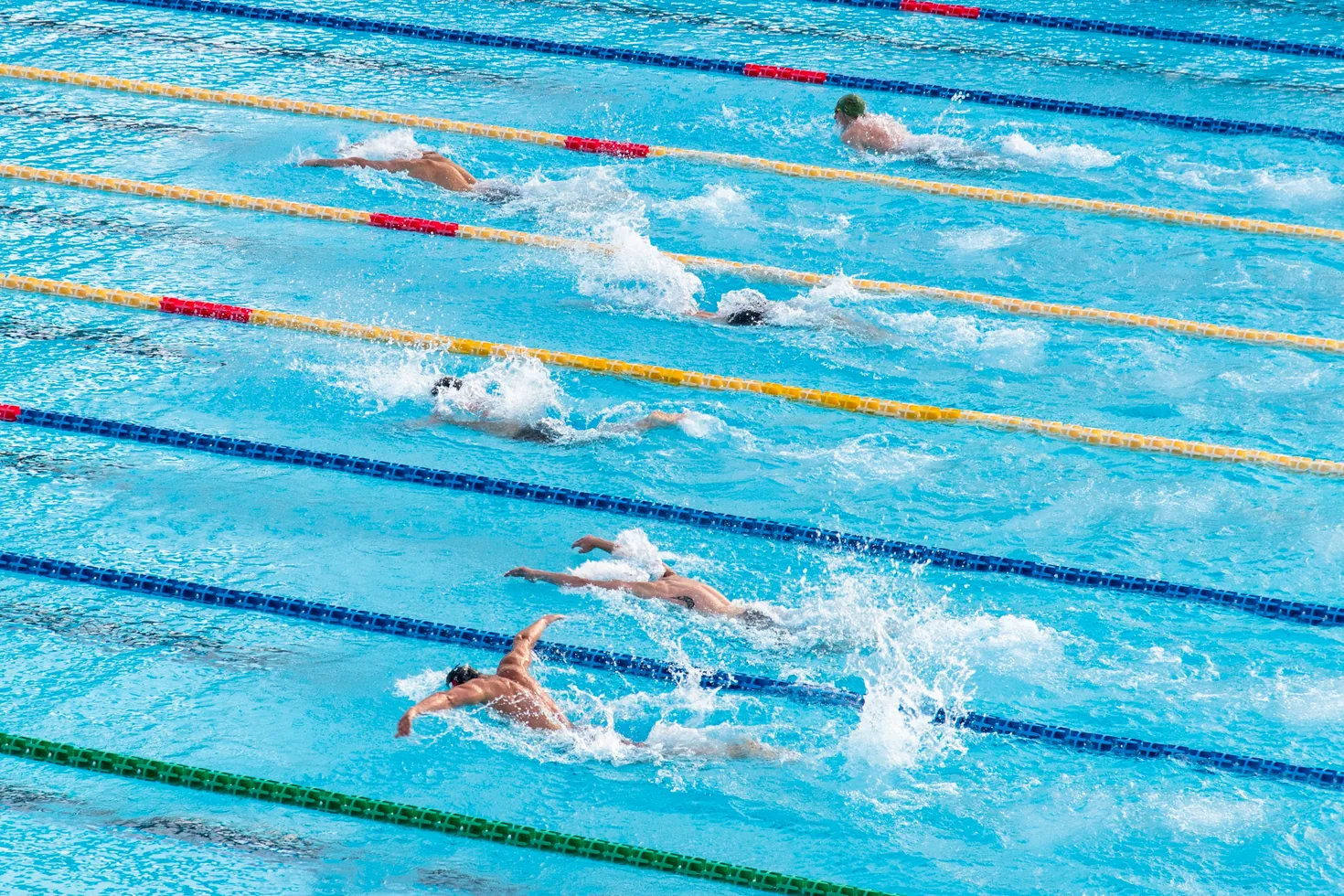
Header photo by Serena Repice Lentini on Unsplash.
Recording Your Vimo Tempo in Garmin, with FIT Developer Fields
Garmin swim profiles ignore external cadence sensors, so until now your Vimo tempo could not be recorded in a swim activity at all. The new Vimo Swim Field writes it straight into the FIT file.
One Button for Your Watch and Your Vimo
The Vimo Swim data field is coming to the Connect IQ Store - and it learned to measure something new along the way: adherence, how well you actually held the beat. One button now runs your watch and your Vimo together.