
One Session to Learn Your Pace: What a New Swimming Study Found
A peer-reviewed study shows swimmers can learn a new training pace in a single metronome session - and still pace each length more accurately 10 days later, with no device. Here is what it means for your training, in plain language.
How long does it take a swimmer to learn a new pace? Weeks of drills? A season of a coach shouting splits from the wall?
According to a 2025 peer-reviewed study from the University of Genoa, the answer is: one session - if the feedback arrives while you swim, not after.
The short version? Train with a metronome and your body picks up the pace surprisingly fast. And no, it is not just "the device beeps, so I stay on time". When the swimmers took the metronome off, they were still hitting each length far more accurately - even 10 days later. The rhythm had moved from the device into their heads.
Let's unpack what the researchers did, what they found, and what it means for your training. No jargon, promise.
What the researchers actually did
The study involved 24 trained competitive swimmers, around 18 years old, with about 10 years of racing experience. Twelve of them trained with a metronome; the other twelve were the comparison group (more on them below).
The metronome group followed a simple routine on each training day:
- Swim 100 m at a target pace, no metronome.
- Swim sets of 2 x 100 m with a metronome.
- Swim 100 m again, no metronome.
One important detail: the metronome did not tick with every arm stroke. It was set to beep once per length, right when the swimmer should be touching the wall every 25 m.
The metronome itself was an old-school waterproof beeper, an off-the-shelf audio metronome from another brand, tucked under the swim cap, with an experimenter on the deck timing every trial by stopwatch. That is worth stating plainly. This is a study of a technique that any swimmer can buy a beeper for, not a test of any particular brand's smart device, and certainly not of ours.


The pace itself was individual and comfortable - a steady cruising speed you could hold for a long set without blowing up, worked out from each swimmer's own best times.
So the task was: learn to feel the right speed for one length of the pool, and choose your own stroke rate and stroke length to get there.
The researchers measured three things: how far off the swimmers were from the target time over 100 m, how far off they were on every single 25 m length, and how much their lap times jumped around.
The headline result: one session
Before the first training, swimmers missed the target 100 m time by about 3 seconds on average.
After one session with the metronome? The error dropped to about 0.7-0.8 seconds.
The single lengths tell the same story. The average error per 25 m fell from about 1 second to half a second. In other words, their pacing accuracy roughly doubled in one session. By day two, the results had settled - most of the learning happened almost immediately.
Not just a better average - a steadier swim
There is a second result that coaches will appreciate even more.
A swimmer can hit a decent total time in an ugly way: 24 s, then 27 s, then 25 s, then 24 s. The sum looks fine on the stopwatch. The swim was anything but even.
With metronome training, the individual lengths became far more repeatable. The swimmers were not just finishing on time - they were swimming evenly, length after length. That is exactly the skill that saves energy in distance swimming, triathlon, and open water.
What about the coach with a stopwatch?
This is where it gets interesting. The comparison group did similar training, but instead of a metronome, a coach told them their time after every 100 m. The classic "you went 1:20".
That group swam no more accurately after the first day. Some progress showed up on day two, and mostly in the total 100 m time - not in the evenness of each length.
The researchers' explanation is simple. A time called out at the wall is one piece of information, delivered after the swim is already over. A metronome gives you a checkpoint every length: at 25 m, at 50 m, at 75 m. Too early? Too late? You correct while you are still swimming. Feedback during the movement beats feedback after it.

The part that matters most: it sticks
Now the finding that makes this a learning story, not a gadget story.
The researchers brought the swimmers back 10 days after the last metronome session. No device, no beeps. The improved per-length accuracy and the steadier lap times were still there.
One honest caveat, because it changes what you should take from this. The durable gain is in the lengths: how close each 25 m came to its target, and how little the four laps varied. The error on the total 100 m time had drifted back into statistical noise by the follow-ups. So what stuck is the feel for a length, not a guarantee of hitting a whole 100 m on the nose.
Even so, the swimmers had not learned to chase a beep. They had built an internal sense of pace - one that stayed with them after the device came off. In plain words: the body picked up the rhythm, kept it, and made it its own. External rhythm becomes internal rhythm.
The catch: one beep can only teach one rhythm
The authors are open about the limits of their setup, and this part is worth reading closely.
Their audio metronome could pace only one rhythm: the time per length. It could not also guide the stroke rate - how often your arm enters the water. To control both at once, the researchers would have needed two separate devices ticking under one swim cap, or a system of light strips installed on the pool floor. They rejected both as impractical and expensive, and they explicitly call for future research where lap pace and stroke rate are guided together.
The other limits are worth stating in the same breath, because they set the edges of what this result covers:
- Stroke rate and stroke length were never measured. The authors name this as a limitation of their own study.
- Twelve swimmers per group. The sample was powered to detect a large effect and nothing smaller.
- A narrow slice of swimming. Trained freestyle specialists around 18 years old, front crawl only, at aerobic pace, in a 25 m indoor pool. Open water, other strokes, race intensity, beginners and masters swimmers are all outside what was tested.


So the science is clear on the principle: real-time rhythm feedback works, and it teaches. The open question is the tool.
What this means for Vimo
Here the evidence stops and our own work starts, so let's be explicit about the handover. Vimo was not in this study. No Vimo hardware, firmware or cue design was tested, no one from our team was involved, and nothing in the results above is a scientific or clinical validation of our product. Everything in this section is our design reasoning, not a finding of the paper.
What the study used was the simplest possible signal: one beep per length. That already produced the results above. Now imagine what a programmable device can do with the same principle.
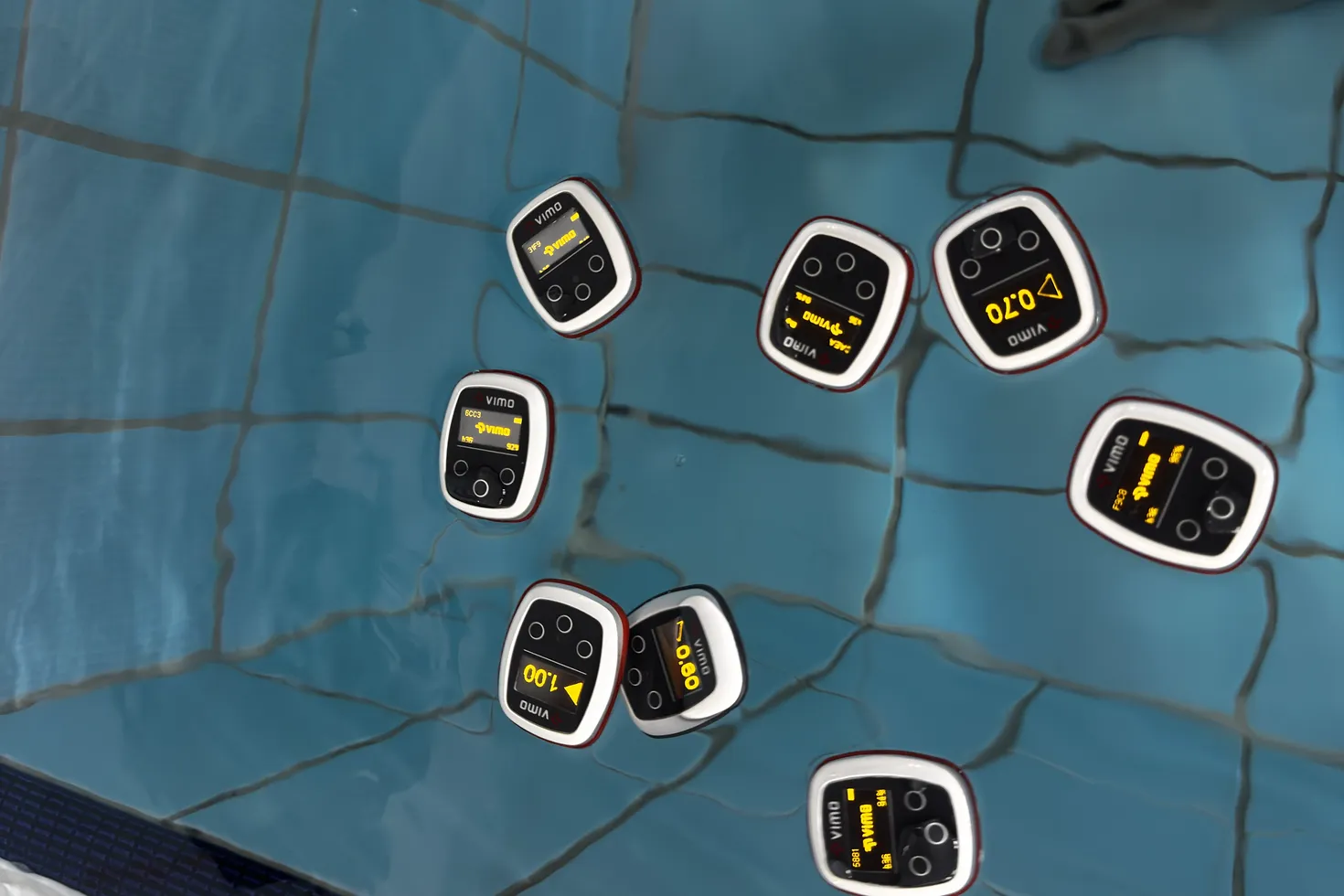
Vimo is built around exactly this idea. It is a waterproof tempo trainer with sound and vibration feedback and fully programmable intervals. One beep every 25 m is just the start: you can program structured sets, tempo changes, and full progressions. And the gap the researchers describe is exactly where we are heading. One device, two rhythms: stroke rate and lap pace, told apart by tone or by feel. One wearable doing what used to take two.
And this is not a slide from a pitch deck. Here is the first working build of the new Combo mode, running on a Vimo:


Two rhythms, set side by side - A for the stroke, B for the wall - exactly the setup the researchers called impractical with the tools they had.
The study gives swimmers a simple, evidence-backed message: rhythm is not decoration. It is one of the fastest ways to teach your body a pace it will remember.
Key Takeaways
The study
Fassone M, Puce L, Biggio M, Avanzino L, Bove M and Bisio A (2025) Metronome-guided training accelerates the adaptation to an aerobic training pace in swimming. Front. Sports Act. Living 7:1588758. doi: 10.3389/fspor.2025.1588758
Independent research from the Università degli Studi di Genova and IRCCS Ospedale Policlinico San Martino, published open access under CC BY. The authors report no funding for the work and no commercial or financial conflict of interest. Vimo had no role in the study, funded no part of it, and none of the authors are affiliated with us. The device they tested belongs to another company.
Want to train your inner metronome? Reserve your Vimo and give your brain the real-time rhythm it learns fastest from.
BeatBuddy Replay: Video Analysis App Challenges
A deep-dive into building a Flutter video analysis app for swimmers. From MVP architecture to cross-platform challenges - lessons from two weeks of development.
One Ride, Two FIT Files: Stitching a Split Garmin Activity Back Together
A 283 km ride, an accidental mid-ride save, and a merge tool I ended up open-sourcing: how fit-stitch rebuilds two Garmin FIT files into one activity Garmin Connect accepts.